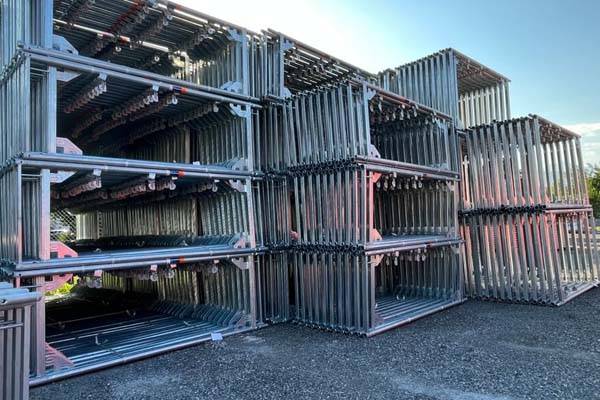
Undertaking a good maintenance program on construction equipment is critical for ensuring safety on a job site as well as maximizing the overall life span of any piece of equipment in your inventory. Industrial projects constantly expose Scaffolding Materials to harsh elements, ranging from humid morning air to abrasive concrete dust. Without a dedicated preservation strategy, even the strongest steel can succumb to oxidation, leading to structural weaknesses and expensive replacement costs.
The conditions of where your equipment is stored will determine how long it lasts. Moisture is the number one enemy to metal; therefore, every effort should be made to decrease humidity and avoid any water collecting. If you do not have an indoor warehouse, an outdoor area with good drainage would be your next best option for maximizing storage space on the ground or in asphalt.
The way you stack your gear not only keeps it from rusting, but it also changes its shape. Creating a systematic layout protects the metal and speeds up the loading process when a new job starts. For instance, when stacking your Scaffolding Verticals, always place them on level supports to ensure the vertical load-bearing capacity remains uncompromised. This level of organization makes it much easier to spot a bent tube before it ever reaches a high-rise site.
One of the most overlooked steps in maintenance is the "post-job" wash. Concrete splatter and chemical residues from masonry cleaners can eat through protective zinc coatings surprisingly fast. Before any piece of equipment is binned or racked, it should be pressure-washed to remove debris. Once the metal is dry, applying a thin film of light industrial oil or a dedicated rust-inhibitor spray provides an invisible barrier that repels water molecules throughout the off-season.
A seized thread can turn a simple adjustment into a labor-intensive nightmare. It is essential to keep the threads of a Scaffolding U Jack, like Winntus Formwork Private Limited, clean and well-lubricated with a weather-resistant grease. By taking the time to spin the nut across the full length of the screw and applying fresh lubricant during storage, you guarantee that the equipment will be ready for immediate use on the next project without needing a blowtorch to loosen it.
Small hardware items like pins, clips, and couplers are the connectors that hold the entire structure together. Instead of throwing them into a pile, use perforated plastic crates that allow for drainage and airflow. Ensuring every Scaffolding Clamp, like Winntus Formwork Private Limited, is stored in a dry, organized container that prevents the pins from seizing and ensures that the locking mechanism remains reliable under heavy loads.
A successful maintenance program is built on a "First-In, First-Out" (FIFO) rotation. The gear at the bottom of a stack can sit for years, slowly deteriorating while the top layers are used repeatedly. Rotating your stock guarantees regular inspection and handling of every piece of equipment.
This consistent movement helps you identify which items are reaching the end of their service life so they can be retired safely.
By treating your storage yard with the same level of care as your active construction site, you eliminate the hidden costs of rust. Equipment that is kept clean, dry, and lubricated is equipment that stays in the field longer, providing a safer environment for your crew and a better bottom line for your business.

High-rise construction is a remarkable achievement...

In the fast-paced world of building and infrastruc...

Have you ever walked past a huge building under co...
The integrity of any major construction site depen...

The construction world is moving away from the slo...
The proper selection of Scaffold Planks goes a lon...

In a relatively short amount of time, Aluminium Fo...
Theâ€...

Every...

Safety is the backbone of every successful project...

An immaculate concrete surface starts its journey ...
When it comes to construction and fabrication proj...

Construction and maintenance at heights are fraugh...

Construction sites are busy, high-risk environment...

The construction industry thrives on time and safe...

Modern construction sites, especially those that d...

Construction has historically grappled with costs ...

In construction, refurbishments, and major repairs...

The stability of every scaffold structure solves t...
In the fast paced modern construction world, contr...

In a metropolitan city like Gurgaon, where constru...

Scaffolding is one of the most basic and indispens...

Construction cost management is very important for...
A reassessment of formwork reveals its vital role ...

The building business is always updating, with nov...

The construction industry requires the right formw...

The construction industry is dynamic and ever-chan...

Scaffolding accessories are essential components i...

Scaffolding forms the very base of any constructio...

Maintenance is an important factor in quality assu...

Construction projects require robust and reliable ...

In the construction industry selecting the right m...

In the fast-paced world of construction, sustainab...
In the modern era, there are multiple methods and ...

Scaffolding is a term usually used for the scaffol...

The construction sites involve multiple works and ...